International Space Station
Visible Passes of the ISS and Other Satellites
The International Space Station (ISS) regularly passes through our skies. It appears like a very bright star moving from west to east, at an angular velocity similar to a plane, and taking a few minutes to cross the sky. During morning passes, especially the very early morning ones, the satellite may be in the Earth’s shadow, and therefore invisible, for the first part of a pass. Similarly, the satellite may enter the Earth’s shadow during the late evening passes, and disappear from view. Note that many other, fainter, satellites are also visible. The ISS is by far the brightest, being as large as a football pitch.

Heavens-Above is an excellent website which provides up-to-date predictions of the ISS and many other satellites for your exact location. For most visual purposes you can use Guernsey on Heavens-Above as an accurate enough location. Then click on “ISS” for Space Station predictions. The table then shows:
- The local time, altitude (in degrees above the horizon) and compass direction to look when it first becomes visible.
- The time, altitude and direction when it reaches maximum altitude.
- And the time, altitude and direction when it disappears.
In the evening the “end” time may be when it disappears into the Earth’s shadow; and in the morning the “start” time may be when it emerges from the Earth’s shadow.
Transits
If you're interested in attempting to capture a transit of the ISS across the Sun* or the Moon, your exact and accurate coordinates are more important. A transit will show the silhouette of the space station as it passes across the bright object behind. These transits are very quick, about 1 second if you're in the correct location, so preparation and planning is important. For this purpose, you may find this Transit Finder website of interest. It calculates the locations and durations of these transits.
Caution
Looking directly at the Sun is dangerous, and especially so with binoculars or telescopes. Special equipment and care is essential. A secure solar filter is a critical safety item.
The exact duration of a transit depends on how high the Sun or Moon is in the sky. In Guernsey, during a summer midday transit when the Sun is at its highest, the ISS is at its closest to us and will travel across the Sun in a rapid 0.6 seconds. Conversely, on a winter afternoon when the Sun is low near the horizon, the ISS is much further away, stretching the transit out to a slower 2.5 to 3.0 seconds. For the Moon, the transits are high and fast in the winter and low and slow in the summer. However, low transits mean a smaller silhouette and more atmosphere to observe through.
Gallery




Launch of the last Space Shuttle Atlantis on 8th July 2011, STS-135, marking the historic final flight of NASA’s 30-year Space Shuttle Program. The four-member crew delivered essential supplies to the International Space Station using the Raffaello multipurpose logistics module.
The Space Shuttle rapidly disappeared into cloud, leaving just a smoke trail.
The International Space Station preceded the Space Shuttle Endeavour, flight STS-118 (next photo) by 3 minutes in this sequence taken on 09 August 2007.
The Space Shuttle Endeavour, flight STS-118, followed the International Space Station (previous photo) by 3 minutes in this sequence taken on 09 August 2007.
The International Space Station (left) preceded (by about 20 seconds and 150 km) by the fainter Jules Verne Automated Transfer Vehicle (ATV) on 31 March 2008. They were passing above Polaris, and through Ursa Major.
The International Space Station moving from Gemini to Ursa Major on 23 November 2011 (Guernsey 60-second all-sky camera image).
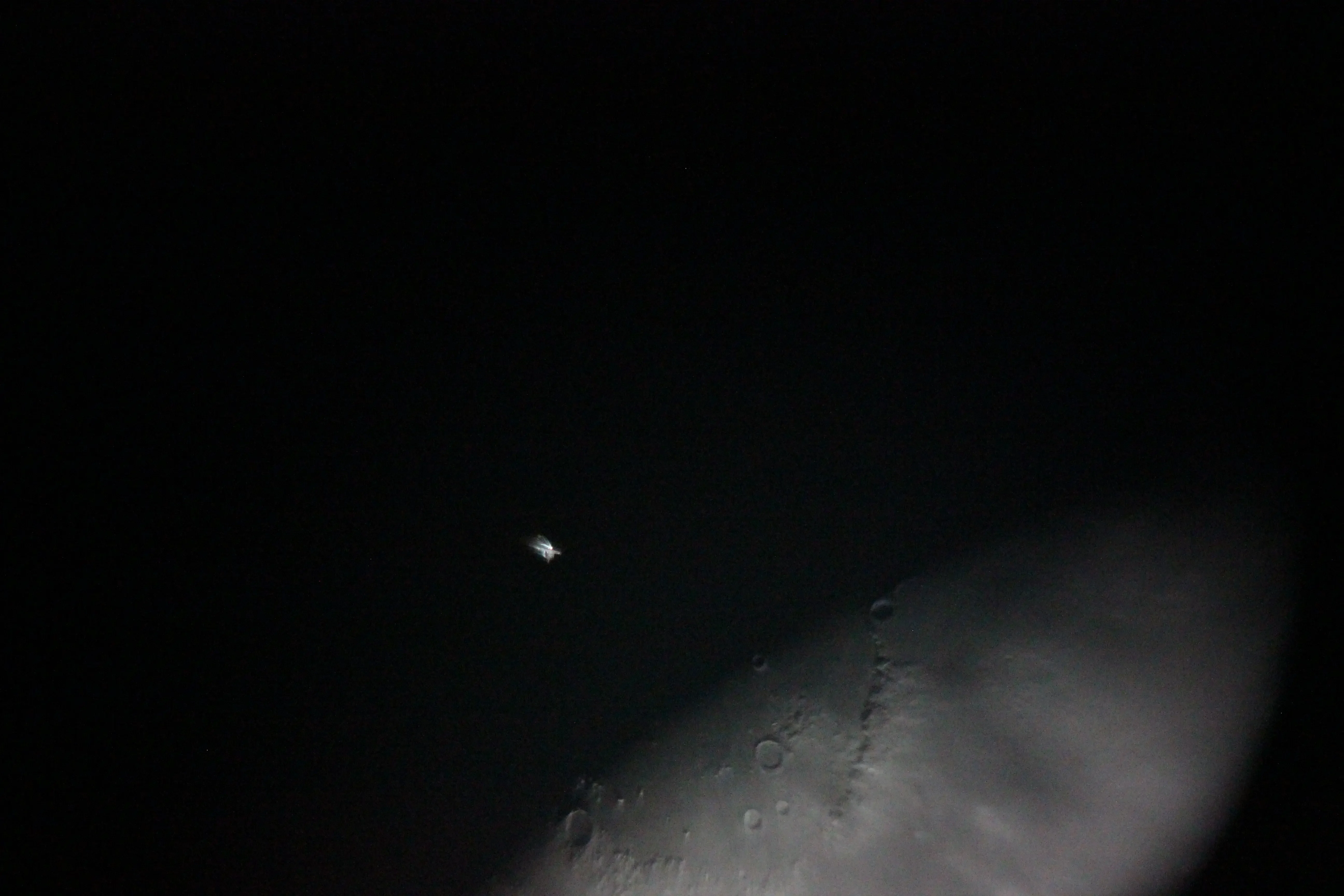
Occasionally the Space Station passes in front of the Moon as in these two images taken on 16 February 2016 and 22 May 2016.
Occasionally the Space Station passes in front of the Moon as in these two images taken on 16 February 2016 and 22 May 2016.
The International Space Station crossing the face of the Sun on 10 June 2017.