
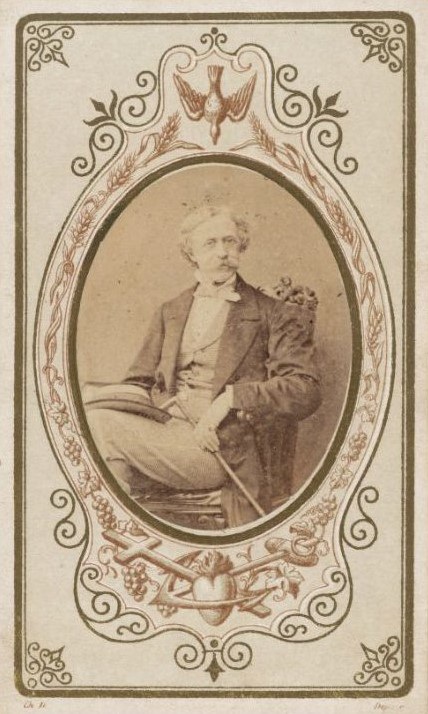
Guernsey’s most famous resident was the French author Victor Hugo, who lived in exile in the island from 1855 to 1870. He purchased a house in St Peter Port in the street called Hauteville, an up-market area on a hill in the south of the town, and transformed it into a remarkable residence where he could continue to write, including completing his masterpiece Les Misérables.
His diary for 3 September 1861 records (in French) that “the Patourel house is rented to a German astronomer named Baron de Gompach”. This astronomer was, therefore, a close neighbour. There are further references to him and his wife in Hugo’s diary entries for 21 and 25 February 1862, and 12 March 1862. These make it clear that Hugo was not only acquainted with him, but entertained him and his wife in his house.1
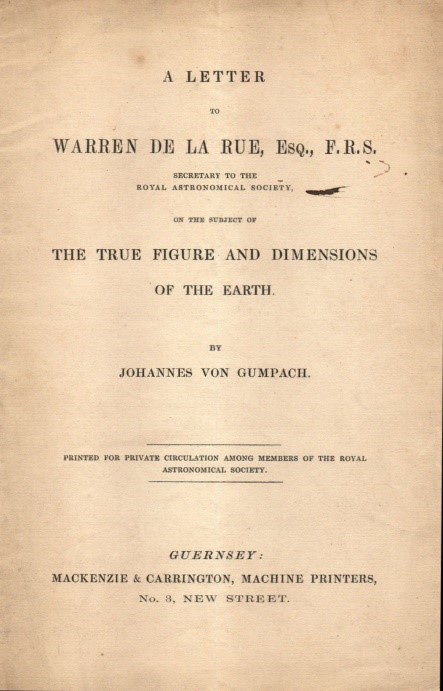
I lectured and wrote about Guernsey astronomers in 2013 3 but it was only later that I became aware of him. Intrigued, I set out to discover more about this ‘astronomer’, and soon struck gold by the acquisition (from Phoenix, Arizona!) of a letter from Johannes von Gumpach in Guernsey to no less than Guernseyman Warren De La Rue, Secretary to the Royal Astronomical Society, together with handwritten notes, undoubtedly by De La Rue himself.
The letter, entitled The True Figure and Dimensions of the Earth, was dated October 1, 1862, and was printed for publication by Mackenzie and Carrington of New Street, St Peter Port. It followed the publication of a far more extensive ‘letter’ from von Gumpach on the same subject addressed to the Astronomer Royal, George Biddell Airy, in the form of a book containing some 270 pages!
I shall return to these letters in due course, but first something about the man himself.
Two puzzles
The 7 April 1861 Guernsey census records “John De Gumpack” [sic], age 41, born in Germany, and living at 14 Hauteville, occupation ‘Pundholder’ [fund holder?], with his wife Julia, age 23, born in England. It must have been a rather crowded house, with three families and three lodgers.

By September 1862 he had moved up the street, and in society, to 42 Hauteville, as recorded in von Gumpach’s correspondence at that time. This was presumably the Patourel house, and was just two doors away from Victor Hugo who lived at Hauteville House, 38 Hauteville.

He is reported to have been born in Fedderwarden, near Wilhemshaven in Lower Saxony on 7 May 1814.4 This would make his age at the date of the 1861 census 47 rather than 41, but that may be a simple recording or transcription error. Details of his family situation, however, are rather a puzzle. Firstly, records being rather sketchy and contradictory, I am not certain what his real name was. The most likely scenario is that his birth name was Theodore Grumbrecht, and that he adopted the name Johannes von Gumpach, along with the title ‘Baron’, probably in the 1850s.5 He certainly invariably wrote and published under this latter name.
Although a number of sources indicate that Theodore Gumbrecht and Johannes von Gumpach are one and the same, it is of course possible that these names refer to two different people. This possibility may explain a second puzzle: that relating to his marriage.
As noted above, in 1861 he was recorded as living with his wife Julia, age 23, and indeed ancestry.com records that he had married Julia Frances Adams, born 1838, in Woodchester, Gloucestershire, and that they had one child whom they endowed with the impressive name, Ernest Desmond James McTaggart Adams St Andrew St John von Gumpach, born in Westminster in 1867. Julia is recorded to have died in Woodchester in 1897.
However, Wikipedia states that in the early 1840s he was living in Clerkenwell, London, and married Jane Wilbraham Edwards (born 1820 in Calcutta, daughter of an Army Colonel) in Cheltenham, Gloucestershire. It is indeed recorded that Theodoric Grumbrecht married her on 9 August 1842 in Cheltenham.6
What is known for certain is that on 9 January 1856 Jane W von Gumpach wrote from Cheltenham to former Prime Minister Lord John Russell thanking him for arranging an application form to be sent to her, being “the means of relieving my husband from his difficulties which at present are pressing heavily on him, but for these the highest prospects are opening to him.” 7
The purpose of the application form and the nature of his “difficulties” are not recorded, but difficulties of one sort or another seem to have been characteristic of von Gumpach’s life. Possibly the application was in relation to citizenship, because he became a naturalised British citizen on 4 June 1859.8
Jane’s letter of 1856 predates his period of residence in Guernsey. We can also be certain that she was his wife at the time of his death in Shanghai in 1875, as recorded by papers of administration of his estate.9 She died in Lancaster in 1898.
So the St Peter Port census record of 1861 is, therefore, either in error, Jane being recorded as Julia, or it refers to another individual entirely. If Jane was born in 1820 then she would have been 41, not 23. So perhaps the census recorder was told that Julia was von Gumpach’s wife when she was not. Or possibly von Gumpach moved to Guernsey and Hauteville because he had a close relation living there, namely the one recorded in the census.
We do know for certain that he was living in Hauteville in 1862, and wrote and published many letters from there.
His life
He was employed for ten years by the bank Huth & Co in London (Frederick Huth being a German-born British merchant). This employment came to a dramatic end in 1843 less than a year after his marriage when he was arrested aboard a ship leaving for New Zealand and charged (under the name of Theodore Grumbrecht) with embezzlement of £4851 10s. He had been entrusted by the bank to present a cheque in this sum to the East India Company for transmission to India. The investigation of this crime led to the discovery of a further series of embezzlements of between £2000 and £3000. He was convicted and sentenced to seven years transportation.10 Rather than being transported to Australia he went to live in Nuremberg and Munich for some years, before returning to England. It seems probable that he changed his name and title to ‘Baron’ Johannes von Gumpach at this time in view of his conviction.
In about 1860 he moved to Guernsey, the reasons for this move being unclear. In December 1865 he was still in Guernsey, living at the Old Government House.11 At that time the OGH had ceased being a hotel and was leased, so he may well have had rooms there.
In 1866 von Gumpach was appointed Professor of Mathematics and Astronomy at a new college in Peking: the Tongwen Guan College (School of Combined Learning). It had been established by the Chinese imperial government for the teaching of western languages and sciences, and was the first modern institution of high education in China.
There were problems, however, in establishing an astronomy class and the creation of an observatory, much to von Gumpach’s upset. He claimed that he had been told that it would be at least seven years before an astronomy class could be formed. He refused to teach mathematics, being what he referred to as “an indignity to a man in his position”, and he was unpersuaded to learn Mandarin so that he could teach pupils before they learned English. So he taught neither mathematics nor astronomy, while still drawing his salary of £600 per year. In 1868, being then referred to as “Fang-Ken-pa”, he was offered, and apparently accepted, a year’s salary and a free passage home on his resignation. But he disputed the agreement to resign and stayed in China, expressing the wish “to write the history of Chinese astronomy and mathematics.” He left Peking for Shanghai, stating that he was seeking a legal decision on the dispute.12
Most of these issues were dealt with by Sir Robert Hart, a British diplomat and Inspector General of Customs in the Chinese government, who had appointed von Gumpach to the China post in the first place. He stated that von Gumpach’s absence from the Peking College was unauthorised and that he had declined to perform his duties as Professor. The Chinese Government thereupon dismissed von Gumpach in late 1869, whereupon he sued Hart in the British Supreme Court for defamation, claiming that Hart’s actions were malicious.
Von Gumpach won the case and was awarded substantial damages in the sum of £1,800 13, but Hart then appealed to the Judicial Committee of the Privy Council. In 1873 the Judicial Committee agreed that Hart’s reports to the Chinese Government were defamatory, but expressed the view that such reports “are prima facie justifiable” and were not malicious. It found against von Gumpach, and ordered him to pay the costs of the Appeal.14
Johannes von Gumpach died two years later in Shanghai.
The True Figure and Dimensions of the Earth
Von Gumpach was a prolific writer. A sample list of his many publications appears in the box at the end of this article. While most of them appear to be academic in nature, the astronomical ones (most of which appear to have been written while he was resident in Guernsey) at least seem to be rather pretentious attempts to challenge accepted scientific opinion, and lacking rigorous scientific argument. His ‘letter’ on the subject of “The True Figure and Dimensions of the Earth” to the Astronomer Royal, George Biddell Airy is a case in point.
In the preface he refers to “Sir Isaac Newton’s erring imagination”. His conclusion, contained in almost 300 pages, was that the Earth’s equatorial diameter is less than its polar diameter in the proportion 1:95, and that there was an error of 167 miles in the circumference of the Earth. This was long known to be false. Newton, for example, had deduced by 1687 that the Earth was an oblate spheroid 15, and meridian arc measurements over the succeeding centuries, culminating in the 2820 km Struve Geodetic Arc (1816-1855), confirmed this conclusion, giving a flattening of one part in 294. (Today’s WGS 84 spheroid used by GPS systems for the figure of the Earth results in a proportion of 1:298.25, by which the polar radius is less than the equatorial radius.)16
Von Gumpach claimed that he had based his conclusions on a number of the reported meridian arc measurements, together with reported pendulum observations. He calculated that because of Newton’s “erroneous theory” 10,000 human beings – the majority of them British sailors – had perished, and that property worth between 25 and 30 million pounds had been lost. He urged Airy to propose an expedition to measure the earth’s equator. He estimated “the losses at sea, resulting from Sir Isaac Newton’s theory of gravitation and the present system of astronomy, as applied to the practical purposes of navigation, to amount, in round numbers, to at least five hundred human lives, and a million pounds sterling worth of property, annually”.
Airy gave no credence to these claims, clearly wasted no time in studying them, and made it quite clear that he had no intention of proposing the expedition. Upon von Gumpach’s persistence he gave him a very curt response. Von Gumpach continued to press his case, referring to “the wreck of colossal national wealth, and the corpses of thousands of our fellow-beings, hurried into eternity by the abstract idea of universal gravitation”.17 Alfred Russel Wallace commented that von Gumpach’s warnings had been all in vain. “The Admiralty persist in refusing to alter the Nautical Almanack, and the philosopher thinks he has just cause of complaint because the Astronomer Royal will neither accept his conclusions nor point out the flaw in his argument.”18
Von Gumpach wrote in similar vein to George Stokes (Secretary to the Royal Society), who, like Airy, refused to countenance further investigation of the claims, stating that the Society’s Council had rejected the conclusions of his treatise. Von Gumpach protested, and quoted at length the Society’s own statutes, claiming that the Council had a duty to put it to the members.19
Having got nowhere with the Astronomer Royal or the Royal Society he proceeded to publish his “letter” in the form of a lengthy book, in an attempt to get popular support for his theory and exert pressure on Airy and Stokes.
As mentioned earlier he wrote to Warren De La Rue as Secretary to the Royal Astronomical Society, enclosing his lengthy treatise. De La Rue appears to have taken his 14-page printed letter seriously enough to make marginal notes, comment on each of von Gumpach’s “enunciations”, and write six sides of calculations analysing von Gumpach’s arguments.
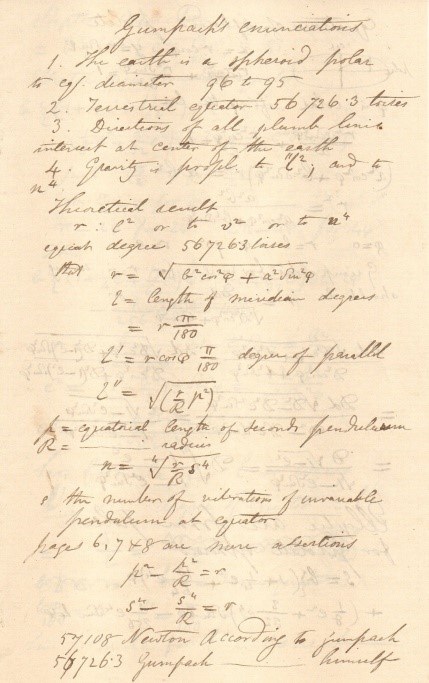
De La Rue noted that von Gumpach’s equation for the terrestrial radius vector for each half degree of latitude was incorrect, as was his formula for the length of meridian degrees. Further, that his deduction that all plumb-lines to the surface of the Earth intersect at the Earth’s centre was true only if the Earth was a sphere. In a marginal note, however, De La Rue commented that von Gumpach’s proposal for an expedition to the equator “seems a very good & sensible suggestion.” Whether any of his observations were communicated to von Gumpach, however, is uncertain. No response has been found in the Royal Astronomical Society’s archives, and the Monthly Notices merely record that the letter was read at the Society’s monthly meeting on 14 November 1862.21 It does, therefore, seem doubtful that he communicated that view to von Gumpach or pursued it further. Certainly, if he discussed it with Airy he would soon have been disabused of it.
Von Gumpach himself does not seem to have referred to a response from De La Rue, but he accused the latter of “trickery”, saying that the RAS did not record his treatise from the “List of Presents received.” “Has it been burked? It would seem so. Some years ago certain papers, presented by me to the same Society, met with the same fate.” 22
Balfour Stewart of Kew Observatory, who worked closely with De La Rue, poked fun at von Gumpach’s treatise: “behold the earth which had previously been flattened out into an orange, squeezed into a lemon. Gumpach cometh! … Let him not only assert but prove that a number of shipwrecks have happened through a mistake of position, and that these would not have taken place had the Gumpachian theory been adopted, and we shall all swallow his life pills, although he discharge them at us in a very violent manner.” This generated an angry response from von Gumpach, fully published by him.23
Frustrated, von Gumpach wrote to Sir John Herschel in rather patronising tones and scathing about Airy: “From Mr. Airy, however, the new-born truth, repulsed by him, now turns for protection and acknowledgment to men like yourself who are above the narrow-minded prejudices and jealousies of the professional astronomer, to whom the love of science has been the guiding star of their life, devoted to its service, and who desire to live in the Future even more than in the Present, which can add no further lustre to their name.”
Ever the self-promoter and with totally unrealistic opinions of his achievements, he claimed that the polar elongation of the Earth and the new pendulum laws which he has established “are but two of a series of similar discoveries, even of greater moment to science, I have had the good fortune to make. Indeed, I may venture to say that I have completed the first general outlines of an entire new system of theoretical and physical astronomy … and in the course of about ten years more, perhaps, I may hope to bring them to something like maturity.” He likened himself to Galileo and Copernicus, in that they similarly opposed the whole scientific and intellectual world.
Herschel, like Airy and Stokes was equally disdaining of von Gumpach’s theories, whereupon he claimed that Herschel could only have read the first 15 or 20 pages, and asked that he read the whole before giving his opinion as to whether to support a submission to the government for an expedition to measure an arc of longitude on or near the equator in order to decide whether the Earth is elongated as to its polar diameter.
Herschel responded unequivocally: “I consider that question is already definitely decided in the negative, and that I should no more think of measuring such an arc for such a purpose, than to decide (to use your own illustration) whether two and two make five and not four …”. “Meanwhile as I perceive we are not likely to agree I would respectfully suggest the undesirableness of our further correspondence on the subject.”
Von Gumpach was again patronising: “… it must be a matter of grief for any one to find that the son of Sir William Herschel is forsaking the cause of Science and Truth.” Having agreed that any further correspondence was undesirable he nevertheless continued for six pages arguing against Herschel’s findings.24
Von Gumpach sent a hand-written letter also to Norton Shaw, Secretary to the Royal Geographical Society, on the 1st October 1862, and then sent several printed copies of his letter. Not having had any response, he wrote again, on the 29th November, in pained terms: “Is it that the discovery of the Earth’s polar elongation and of the true pendulum laws disentitle me, in your eyes, to that courtesy which gentlemen, in whatever position they are placed, usually consider it a duty towards themselves to extend to others?” The Society’s Council decided not to refer nor read it to the Society, and a curt reply was sent to von Gumpach on the 2nd December: “Dr Shaw … regrets to say that it has not been directed to be read.”, whereupon von Gunpach appealed, apparently in vain, to Sir Roderick Murchison, President of the Society.25
Von Gumpach sent his treatise to the British Association for the Advancement of Science (Secretary William Hopkins), and recorded a response from geologist John Phillips (Assistant General Secretary) saying that it was not ordered to be read, but that printed copies were placed on the table of the Association’s meeting. This got a characteristically strongly worded and quite rude published response from von Gumpach about Phillips: “He judges too confidently, where he is manifestly incompetent to judge, He knows too little of what he ought to know. He accepts shadows for substance; and mistakes existences for dreams. Let us hope that his knowledge of Geology is as deep, as his general knowledge appears to be shallow.”26
A wasted talent?
Von Gumpach has been described as: “a maverick scholar, writing on astronomy, Assyrian and Babylonian history, the Old Testament, … philosophy, and Newton’s erroneous understanding of gravity. China has attracted its fair share of foreign crooks, cranks, swindlers, and eccentrics. Von Gumpach was one of these.” 27
It is generally acknowledged that his scientific writings are of doubtful value. He refused to recognise the errors in his treatise on the form of the earth, for example. In reference to his opposition to Newton’s theory of gravity, American biologist Nathaniel Gist Gee said: “In explaining the attraction of bodies, von Gumpach placed greater emphasis on the nature of the space surrounding a body than on the body’s mass. There was inspired genius to his ideas, but most of his theory, as well as his evaluation of its place in the history of science, was delusional.” 28
Contemporary comments acknowledge that his published works, especially his historical and religious writings, showed talent, but were badly devalued by his aggressive character, critical nature and obduracy. Comments collected by Shanghai based editor F H Balfour from Chinese and Japanese newspapers 29 include, for example:
“Baron von Gumpach’s last book … will compel attention and admiration; but the inherent faults of his mind are everywhere in it …”
“In spite of the bitter feeling which runs through the whole of the present work, it throws much light …”
“Von Gumpach was evidently one who had an overweening estimate of himself, who implicitly believed in the correctness of his own judgment and his powers to set all things right, from theories about the motions of our solar system to the minutiae of Customs returns … his statements have to be taken with extreme caution. He wrote with the zeal of a partisan, and nearly all his productions were spiced to a large extent with personal animosity.”
“The announcement … that this work was in the press gave rise to some curiosity, tempered with regret. That the author was a man of talent was on all hands admitted. But he had so thoroughly placed himself beyond the pale of consideration by his vituperative attacks upon the Inspector General of Customs that it was feared any product of his pen would, like his “Burlingame Mission”, utterly fail in creating any impression owing to the malignity of the writer.”
In reporting on his Baby-worlds publication, the magazine Spectator said that he contended that comets were living things sent to supply the place of worlds which die. “Mr. Von Gumpach is obviously either a greater [scientist] than Newton, or else – insane.” 30
The memoirs of diplomat and Professor of Chinese, Herbert A Giles (1845-1935), refer to him as “that strange figure … who flitted briefly across the literary stage in China.”
Von Gumpach presents as a very sad figure. He clearly had considerable talent, a deep interest in science, religion and ancient history, was fluent in English and German (and possibly other languages), and must have had some independent source of wealth to pursue his researches. He was marred by a fantasy of the importance of his scientific pursuits, a dubious morality, and a highly litigious and argumentative nature. One does wonder how his wife coped with his character verging on megalomania, his inability to hold down a job, and undoubtedly his feeling (probably justified) that the world did not value his pretentious analyses.
In his own words: “It has fallen to my unenviable lot, to recognise a series of hitherto unnoticed facts in astronomy, constituting discoveries, to which, for number and importance, the history of Science presents no parallel, and involving – to use the words of Sir John Herschel in reference to one of these facts – “the total subversion of all that is now considered to be established science:” that is to say, the complete destruction of the Theory of Universal Gravitation, and of the entire system of modern Theoretical and Physical Astronomy.” 31
A curious case indeed. I wonder what Victor Hugo made of him!
Von Gumpach’s astronomical publications include:
- A Popular Inquiry Into the Moon's Rotation on Her Axis (1856).
- A million’s worth of property, and five hundred lives lost annually at sea by the theory of gravitation (1861).
- The True Figure and Dimensions of the Earth (Letters addressed to George Biddell Airy, Astronomer Royal; Warren De La Rue, Secretary, Royal Astronomical Society; Sir John Herschel, Royal Society; Norton Shaw, Secretary, Royal Geographical Society; and the British Association for the Advancement of Science) (1862). Written from and printed in Guernsey.
- Baby-worlds: An essay on the nascent members of our solar household. With an appendix, containing various papers and dissertations, astronomical, meteorological and chronological. (1863). Written in Guernsey, published in London.
- Time, Space and Eternity. An essay (1866). Printed in Guernsey.
Other publications include:
- Practical tables for the reduction of Mahometan dates to the Christian calendar (1856).
- On the Historical Antiquity of the People of Egypt: their Vulgar Kalendar, and the Epoch of its Introduction (1863).
- The Treaty-Rights of the Foreign Merchant, and the Transit-System, in China (1866).
- The Burlingame Mission: A political disclosure (1872).
- The Tonnage-Dues Fund, the Harbour of Shanghai and the Wu-sung Bar (1872).
- The Returns of Trade at the Treaty Ports in China (1875).
…together with a number of publications in German:
- On the old Jewish calendar (1848)
- The chronology of the Babylonians and Assyrians (1852)
- Old Testament studies (1852)
- Help book for calculating chronology; Largeteau's abbreviated solar and moon charts, for astronomers' and chronologists' manual use (1853)
- Demolition of Babylonian-Assyrian history (1854)
- The Prophet Habakkuk (1860)
Notes
- ^ Gregory Stevens Cox, personal communication.
- ^ Courtesy University of Bristol and the President and Fellows of Harvard College.
- ^ Sagittarius (newsletter of the Astronomy Section, La Société Guernesiaise), January-March 2013, p9.
- ^ https://en.wikipedia.org/wiki/Johannes_Von_Gumpach
- ^ See for example the memoirs of H A Giles in East Asian History, numbers 13/14, June/December 1997, p9, Charles Aylmer (ed.).
- ^ Geneanet, findmypast and contemporary newspaper reports.
- ^ UK National Archives PRO 30/22/13A 90-91, 22.
- ^ UK National Archives FO 917/162.
- ^ Idem.
- ^ Proceedings of the Central Criminal Court, 18th September 1843. He was tried at the Old Bailey, pleaded Not Guilty, but was found Guilty. His age was recorded as 27, making his birth year about 1816. If he was born in 1814 he would have been 29 at the date of his trial. There was a strong recommendation for mercy.
- ^ Preface to his essay Time, Space and Eternity.
- ^ Judicial Committee of the Privy Council, 14 November 1872.
- ^ Judgment of the Supreme Court of China and Japan, 19 April 1871.
- ^ Judgment of the Lords of the Judicial Committee of the Privy Council on the Appeal of Hart v. Von Gumpach, from the Supreme Court for China and Japan, 28th January, 1873.
- ^ Principia.
- ^ https://en.wikipedia.org/wiki/World_Geodetic_System#WGS84
- ^ The True Figure and Dimensions of the Earth, 1862.
- ^ Is the Earth an Oblate or a Prolate Spheroid? In The Reader, 1866.
- ^ Royal Society MS-6-249, MS-6-254, M-6-262.
- ^ Author’s collection.
- ^ MNRAS 23 (1863), p152.
- ^ ‘Our Weekly Gossip’ a critico-anticritical medley, by von Gumpach, London, 1866, Page viii. To ‘Burke’ means to supress quietly, from the 1828 murderer William Burke who smothered his victims (OED). I have found no reference to the earlier papers mentioned by von Gumpach.
- ^ In the Edinburgh New Philosophical Journal (New Series, Vol xvii, No. 1 for Jan. 1863, pp 105-107), quoted in ‘Our Weekly Gossip’, id Pages 83 and 85, et sec.
- ^ Royal Society HS-9-72 to HS-9-77.
- ^ RGS/CB5/253&621.
- ^ ‘Our Weekly Gossip’, id Page 111.
- ^ Breaking with the Past: The Maritime Customs Service and the Global Origins of Modernity in China, by Hans van de Ven, 2014. It contains a succinct account of von Gumpach’s dispute with Hart.
- ^ China Voyager: Gist Gee’s Life in Science, by William J Haas, 1996.
- ^ UK National Archives FO 917/162.
- ^ The Spectator, 10 October 1863, p23.
- ^ ‘Our Weekly Gossip’, id Page 109.